
Ntendeni Luvhengo who is currently working with us at Modjaji Books as a publishing intern, took time to interview Hannah Botsis.
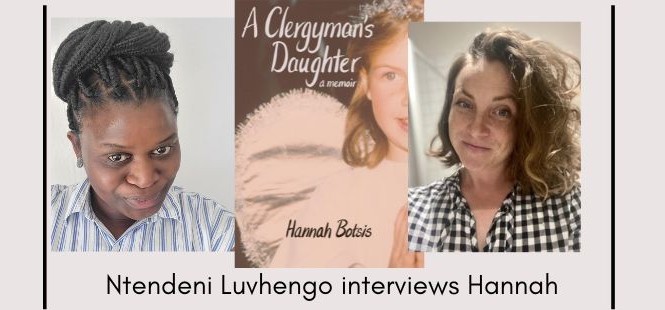
Ntendeni Luvhengo (LV): What inspired you to write A Clergyman’s Daughter?
Hannah Botsis (HB): I’ve always wanted to write about the community I grew up in. As a case study I think it offers an interesting window into an under-explored, but very common, slice of South African life – a small religious community that is a microcosm of all our best and worst characteristics as a nation. When my father retired, and I had young kids of my own, I found I had a lot of questions about community, faith and family, so I started interviewing him.
NL: You’ve described your small religious community as “a microcosm of all our best and worst characteristics as a nation.” Can you share some specific examples of those traits, both positive and negative, that you explore in the book?
HB: Hospitality and generosity – like sheltering people during xenophobic violence, feeding the homeless, caring for each other in everyday life as a community, and then racism, refusing to repent for historical errors, protecting patriarchal norms, and white flight.
NL: You say that when your father retired, you began asking questions about community, faith, and family. Which of those questions felt most urgent or difficult, and how did you approach raising them with your father or family?
HB: They were all intertwined. I’ve always been close to my father and our conversations have always involved these topics, but I decided I wanted to formalise the interviews for the sake of the book, so that I knew what was on and off the record, so to speak.
NL: How did you choose the title?
HB: I didn’t have a title for a long time. I’ve always loved Orwell’s writing, his well-articulated concerns about power and society. And then in 2023 I read Orwell’s Roses by Rebecca Solnit (this is wonderful book!) and in it she refers to his lesser-known novel, A Clergyman’s Daughter. Immediately I knew I wanted to have the same title for my book. And luckily titles are not copyrighted.
NL: Is your book a memoir, in the way we usually understand memoirs? Is there another way you might describe the genre?
HB: I don’t like the word memoir really. It sounds a bit poncy. I feel like ‘life writing’, or ‘writing reality’, more accurately captures what I’m trying to do. Making a social commentary using one’s own life as the lens/device.
NL: How do you see your book speaking to post‑apartheid South Africa?
HB: I think there are a lot of small and ordinary bits of history we know nothing about, even by those who live in the places where that history took place. I think my book is one of the pixels that make up the bigger picture of South African life.
NL: Growing up, how did you feel about being a clergyman’s daughter? Did those feelings shift as you grew older?
HB: Sometimes I felt self-conscious about my father being a minister, mostly in front of people who see the clergy as some special category of holy human (which they aren’t), and by extension these expectations are placed on his family. But as I got older I actually thought it was really interesting, this somewhat antiquated profession focused on care, teaching and devotion. It made me wonder about who was doing that kind of work now? Or is it just vanishing from social life and being replaced by therapists and charities?
NL: Which themes felt most urgent to explore in your book? Why? Did you have the themes upfront, or did they emerge as you worked on your manuscript?
HB: I think the contradiction between the doctrine of radical love on the one hand and the church’s appalling history of racism on the other. This has always been in my mind. But I wanted to explore it from the inside out. Understand how congregants themselves resolve these tensions, if at all. And how do you care and teach through this contradiction as a clergyman. What does a life of faith even mean?
NL:What do you hope readers take away from reading your book?
HB: That not all religious people are nutjobs but at the same time religious people have a lot to answer for. But then, these two things are also the hallmark of being human – having a great capacity for love and yet messing up again and again. My hope is that people might be able to have more grace for each other, even when they don’t understand each other.
NL: Did writing the book change your view of the past? If so, how, and can you give an example?
HB: Not really, but it certainly added more texture, more detail, to how I understood my family and its relationship to broader South African life, and I think it made me more compassionate and more humble. Less fiery critique and more appreciation for how complicated life can be.
About the Writing Process
NL: What was your starting point when drafting your book?
HB: I was trying to unlearn my academic writing practice. Trying to be more creative and free. Lots of writing resources recommend starting with your childhood, with specific artifacts. I sat down and wrote up a description of my childhood home in great detail, from our kitchen table, to the books on the shelves and the taste of the water in the bathroom taps. Lots of memories and questions started coming up.
NL: How did your academic background shape your writing style?
HB: My background is in narrative research and I think this was really helpful in working with interview material, and fusing it with sociological description. Narratives allow us to tend to big questions (“what kind of society are we?”), but using individual stories as starting points. It is an amazingly productive technique. Every person has a story, and their class, race, religion, accent, gender, domicile all point to social influences and allow us to sketch a picture of something bigger than just one story. But because it is ‘just’ one story, it remains accessible.
NL: Did you write chronologically or thematically?
HB: I interviewed chronologically, and then ‘coded’ my material thematically. The book itself moves around a bit.
NL: You mention that you interviewed chronologically and then “coded” your material thematically. For readers unfamiliar with that process, can you explain what coding means in this context?
Coding simply means labelling and categorising in a systematic manner. So you pick a theme – it can be a thing or a concept, and then note every instance of this occurrence. Then you see where there might be connections between things to create more complex or compound themes.
So for example, a code could be ‘eating together’. So you would note every instance of eating together: suppers, community gatherings, occasions. Then you could re-code by space – was this in people’s homes? At the church? At a night shelter. Then you could attach a concept like ‘fear’. You re-read all those instances and ask, was fear present or absent when people ate together. Why or why not? It is not as clinical as this is making it sound, it is quite organic, depending on what catches your attention or what you want to communicate to the reader – but it provides a method to move through large chunks of text methodically.
NL: How did you balance honesty with compassion in telling family stories?
HB: I come from a wonderful family where one of our core beliefs is that love and critique are not opposites, and that you need both in relationships. That’s how I was raised and that’s how I wanted to write the book.
NL: Memoirs are personal and can sometimes be uncomfortable to write. Were there stories you debated including to protect your family’s or community’s privacy? How did you navigate that?
HB: Yes, definitely. I still worry about whether it was expedient to include so many stories that weren’t ‘mine’. But they were mine in the sense that they were in circulation in my life, and I had made my own interpretation of them and that is what is in the book. I did give a copy to my family, and to anyone who I thought needed to see certain sections. There were one or two things I excluded after this process, but on the whole I was pleasantly surprised by their response. The vibe was kind of – ja, this is a bit tough to read sometimes, but it is true. What a robust bunch! I’m very fortunate in that regard. I anonymised anyone I hadn’t sought explicit permission from.
NL: Which writers and/or books influenced your approach? How?
HB: Jeanette Winterson. I love her. Her novel Oranges Are Not the Only Fruit was a semi-autobiographical novel about growing up as a queer person, and adopted daughter, in a conservative religious community. She managed to balance wry social commentary, personal narrative and family drama so well. I wish I had that ability. She wrote that novel when she was very young and then about 25 years later she wrote a non-fiction book telling the same story called, Why Be Happy When You Could be Normal? I loved her treatment of the story in both books. It showed me how capacious personal narrative can be.
Then in terms of questions about formal religion and a life of faith, My Bright Abyss: Meditation of a Modern Believer by Christian Wiman completely transformed my own relationship to the church. This book showed me that we actually need some kind of dogma, some kind of script, some kind of institution, to access the divine because we are such weak little creatures there is no hope of us ever doing this on our own. We need words that we share with others to articulate both our wonder at being alive and our extreme despair at being alive. And then to move us into action.
NL: What advice would you give to someone writing about family
HB: Be honest, be kind, don’t be sentimental. And that old chestnut, ‘show, don’t tell’.
NL: What writing project are you dreaming of next?
HB: I’d love to write about the chaos of being a mother to young kids in Johannesburg. What does it mean to be a parent in one of the most unequal cities in the world?
Ntendeni Luvhengo is a self-published author of The Aborted Stone and Involuntary Gap Year (Kindle Direct) and holds a BA with Joint Honours in Translation and Publishing Studies from Wits. Writing in both English and Tshivenḓa, she also works as an editor and proofreader in both languages. Passionate about multilingual expression and inclusive publishing, she advances Tshivenḓa literature through translation and editorial expertise, nurturing diverse voices and shaping a dynamic literary landscape.